Systems SIG: Systems Change: What the Guidance Offers and What It Means for Evaluation (Online 20 November 2026)
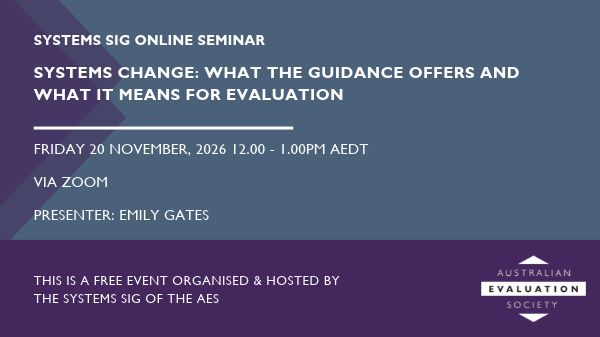
Date and time: Friday 20 November 2026, 12.00pm -1.00pm AEDT
Topic: Systems Change: What the Guidance Offers and What it Means for Evaluation
Location: online via zoom, details will be shared just prior to the event
Presenter: Emily Gates | Boston University
Register online by: 19 November 2026
Event description:
What does it mean to work towards systems change, and how can evaluators help people understand whether their efforts are making a difference?
Emily F. Gates will draw on her recent co-authored article, “Decoding a Decade of Systems Change Guidance, 2014–2025: Building a Shared Framework for Collaboration”. The paper reviews 46 practical guides published between 2014 and 2025, identifying common ground in how systems change is understood, pursued and evaluated.
The review starts from a familiar problem…systems change frameworks use different language and assumptions, making it difficult to see how they fit together. The authors identify five recurring phases… exploring the situation and envisioning change; mapping systems; finding leverage; navigating futures; and learning and adapting. These offer a shared framework for practice.
For evaluators, the review raises an important challenge. Although learning and adaptation feature prominently in the guidance, evaluation is often underdeveloped. The session will explore how evaluators can help people examine assumptions, understand relationships and power, assess progress and adapt their actions as circumstances change.
The session will explore:
• What distinguishes systems change from improving an individual programme or service?
• What common ground exists across systems change frameworks, and how can it inform practice?
• How can evaluation be integrated throughout a change effort rather than added at the end?
• What evidence helps us judge changes in relationships, institutional arrangements, power and underlying assumptions?
• How can evaluators support learning and adaptation while making credible judgements about progress and contribution?
A central question for discussion:
When an initiative says it is pursuing systems change, what should an evaluator look for—and what would count as credible evidence of progress?
The session is intended to leave substantial time for participants to connect the findings to their own work. It examines shared insights and gaps in published guidance; the review does not test which frameworks are most effective in practice.
Presenter details:
Emily F. Gates is Associate Professor of Evaluation at Boston College. Her work explores how evaluation can help people and organisations address complex problems and support systems change, with a particular focus on systems thinking, values and equity. She bridges research and practice through teaching, collaborative research and evaluations in education and public health. Emily is co-author of Evaluative Inquiry for Systemic Change and Evaluating and Valuing in Social Research, and received the American Evaluation Association’s Early Career Award in 2023.
If this seminar is recorded, it will be available on the member portal only.
This free event has been organised by the Systems SIG of the AES. Our seminar series provides an opportunity for you to meet with AES members and others in the evaluation community and to share and learn from the experiences of fellow evaluators.
Session start times:
VIC, NSW, ACT, TAS: 12.00pm
QLD: 11.00am
NT: 10.30am
SA: 11:30am
NZ: 2.30pm
For other time zones please go to https://www.timeanddate.com/worldclock/converter.html
Please ensure you have access to your email address to receive the zoom details. Please also check your email address is correct on your registration form before submitting.
Event Information
| Event Date | 20 Nov 2026 12:00pm - 1:00pm |
| Cut Off Date | 19 Nov 2026 4:00pm |
| Location | Zoom |
| Categories | Special Interest Group (SIG) |
We acknowledge the Australian Aboriginal and Torres Strait Islander peoples of this nation. We acknowledge the Traditional Custodians of the lands in which we conduct our business. We pay our respects to ancestors and Elders, past and present. We are committed to honouring Australian Aboriginal and Torres Strait Islander peoples’ unique cultural and spiritual relationships to the land, waters and seas and their rich contribution to society.