
AES Voices | Our People | Our Stories
Finding your people. Sharing your experiences.
There's no single pathway into evaluation, and you don't have to call yourself an evaluator to be part of the AES community.
Our members come from all walks of professional life - evaluation, policy, research, education, government, community development and beyond. What connects them is a shared curiosity, a commitment to learning and a belief in the power of evidence to make a difference.
Through AES Voices, we're sharing the stories of the people who make our community what it is.
And one message keeps coming through: AES is about more than professional development. It's about finding your people.
It's the connections, conversations, friendships and opportunities to learn from one another that make this community special, whether you're just starting out, exploring evaluation from another field or have decades of experience.
Explore the stories below and discover the many different journeys, perspectives and people that make up AES.
Because there's more than one way to be part of evaluation, but we all benefit from being connected.
We’d love to hear your story!
Whether you’re an evaluator, policy professional, researcher, educator, or someone who believes in the power of learning and evidence to make a difference, your voice can inspire others to connect, learn, and join the AES community. Your story will help others understand what AES is about and inspire more people to connect, learn and join. We’re looking for authentic personal reflections that show why evaluation matters and what being part of AES means to you. Express your interest by emailing
Marwan El Hassan
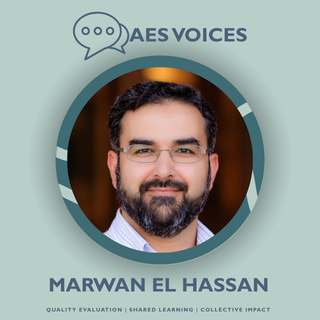 |
Organisation: Department of Agriculture, Fisheries and Forestry Position: Director Location: Canberra AES Member Since: 2024 LinkedIn: Marwan El Hassan | LinkedIn |
What first inspired you to join the Australian Evaluation Society? I’m a scientist by training and came to evaluation when I was asked to establish and lead a fabulous small team responsible for monitoring, evaluation and learning. When I looked for training, AES workshops were a natural starting point. I became a member, and we took up an organisational membership so more colleagues could benefit from AES learning opportunities. I particularly value the special interest groups (SIGs). With my background in systems thinking, I found a natural home in the Systems SIG.
What do you wish more people understood about evaluation? That it’s not a tool to punish people! I sometimes see people hesitate to engage with evaluation because they worry it’s about finding fault. I wish more people could see it as a chance to be curious, ask honest questions and learn together. For me, it’s about understanding what’s working, what isn’t and why, then using that learning to do things better.
What advice would you give to someone thinking about joining AES? Don’t overthink it, just join! I didn’t come with a traditional evaluation background, but I’ve felt very welcome. Beyond the learning opportunities, it’s the people and the connections I’ve made that I really value. You don’t need to have it all figured out before joining. Come with your curiosity and a willingness to get involved.
Greg Masters
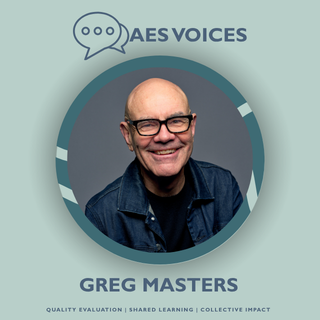 |
Organisation: Nexus Management Consulting Position: Director Location: Sydney AES Member Since: 2016 LinkedIn: Greg Masters | LinkedIn |
What makes the AES community special to you? It's nice to be with a bunch of people who don't need "evaluation" explained to them! More seriously, the AES is diverse: it is not just for "experts" but provides a space for people of different backgrounds and experience to develop their skills and share, and test, ideas. As someone who is nearing the end of his career (if that is not too ostentatious a term!) I relish mentoring people who are taking their first steps in evaluation, some of whom are already very accomplished in their careers. I learn as much, if not more, from them. And I have loved being part of the NSW Committee where I’ve made some great new friends and professional colleagues.
What do you wish more people understood about evaluation? What it means! I'd like to have been much better at explaining what evaluation is; it could have saved me lots of awkward silences and stilted conversations! In fact, I think we all need to be better at explaining evaluation in plain terms: did this program work? What could we change to make it better? Is it worth the effort? I think too often evaluation is seen as mysterious and technical activity rather than something that can help answer these fundamental sorts of questions.
What makes evaluation a profession that matters? I know that this may be heresy in the AES church, but I still remain to be convinced that evaluation is a profession! Lots of amazing evaluation work is done by people who wouldn't call themselves evaluators: epidemiologists (where I acquired some of my evaluation skills), research agronomists (where one of my first evaluation bosses worked), educational psychology and so on. However, that is not to say that evaluation doesn't matter. It matters enormously...indeed, those working in government and NGOs should have basic evaluation skills and bring evaluation thinking to their work. Evaluation helps us answer those basic questions.
What advice would you give to someone thinking about joining AES? Just do it. It’s a very accepting, diverse community and nothing like some stuffy professional organisations. You will be welcomed. And I’d thoroughly recommend volunteering to join your regional committee, even if you are fairly new to evaluation. It’s a fun way of meeting evaluation colleagues and a great way of learning, regardless of your level of experience.
Belinda Hendrickson
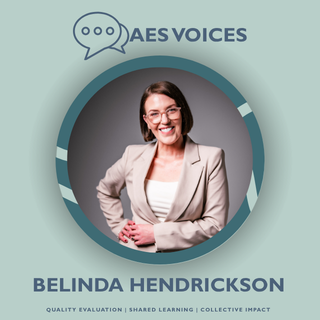 |
Organisation: Connected Impact Advisory Position: Founder Location: Canberra AES Member Since: 2026 LinkedIn: Belinda Hendrickson | LinkedIn |
What first inspired you to join the Australian Evaluation Society? When you go out as an independent consultant, you leave behind the many wonderful colleagues, the shared knowledge and the impromtu “can you have a look at this?” conversations that an organisation readily affords you. I joined the AES to tap into a collective resource. Being a member of the AES is a way to stay up-to-date on current evaluative practice, keep learning, and know what good looks like, because best practice keeps moving and I didn’t want to be guessing at it on my own.
What makes the AES community special to you? Evaluators are a very generous bunch! In my experience, people in the AES community share what they know freely, with no sense of competition. They’ll offer an idea, an introduction or a hard-won lesson and then ask how they can help you further. There’s a real culture of support and collaboration, and it means you can walk into a room as a stranger and leave with your people. When you’re starting out, or going out on your own, that belonging is worth substantially more than any template or tool!
What advice would you give to someone thinking about joining AES? Join the AES, then show up. Go to the event, say yes to the coffee, and ask the question you think is too basic (I can tell you, it probably isn’t). The true value comes from the people, and they’re extremely generous with their time and knowledge. Whether you’re early in your evaluation career or going out on your own, there’s a place for you in the AES community, and you’ll probably find your people much faster than you expect!
Patricia von Baumgarten
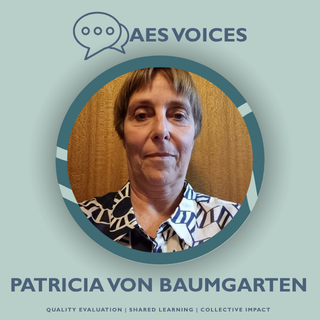 |
Organisation: Department of Agriculture, Fisheries and Forestry Position: Assistant Director Location: South Australia AES Member Since: 2015 |
What first inspired you to join the Australian Evaluation Society? I was inspired to join the AES because it was the only organisation dedicated specifically to Evaluation that offered many resources and activities to help me keep up to date with the changes in the discipline. Also, it had a friendly group of dedicated people who were very welcoming and embraced diversity. A well-rounded organisation with professionals dedicating their time as volunteers for the benefit of many. I believe this is still the case today.
What does being part of AES mean to you? Being part of AES brings me a wonderful feeling of belonging. I relate to people with similar goals and inquiring minds who inspire me to be a good professional and to do my very best. I like being part of an organsation that encourages sharing with learning, allows for the challenge of conventions and embraces innovative thinking whilst maintaining high standards.
What makes the AES community special to you? A special aspect of the AES community, which I value so much, is how AES members are always referring to past scholars who are no longer with us but left an amazing legacy in the discipline of Evaluation. Much respect and tributes are paid to those who paved the way and made Evaluation what it is today.
What makes evaluation a profession that matters? Evaluation helps public servants, like myself, to better manage public resources by ensuring scrutiny of how these resources are used for the achievement of public good. Through the undertaking of Evaluation and engagement of professional evaluators, transparency and accountability are exercised. Moreover, it provides the basis for future policy and program design via the learning opportunities it presents.
Piper Normoyle
 |
Organisation: City of Greater Bendigo Position: Evaluation Officer Location: City of Greater Bendigo AES Member Since: 2024 LinkedIn: Piper Normoyle | LinkedIn |
What does being part of AES mean to you? The Australian Evaluation Society provides a sense of connection to a community that shares a commitment to evaluation. Being involved has strengthened my confidence to work in this space, knowing there is a strong network of experienced and supportive professionals willing to share their knowledge and insights.
What’s something you’ve gained through AES that you didn’t expect? Through the AES, I was introduced to the EvaluAdd Program. I never expected this opportunity to arise, let alone that I would go on to participate as a mentor within the program.
Being involved has been an incredibly rewarding experience. It has provided me with the opportunity to share my own experiences in evaluation while also learning from those I mentor and gaining valuable insights into their evaluation journeys. The reciprocal nature of the program has enriched my own practice and broadened my understanding of the diverse ways evaluation is applied across different contexts.
What do you want others to know about what evaluation is or what it could be? Evaluation is a powerful tool for anyone aiming to achieve meaningful outcomes and continuously improve. It challenges us to look beyond what we already know, question our assumptions, and identify opportunities to do things better. Just because something is working one way, doesn’t mean that it couldn’t be improved or work better by considering additional elements or options. Evaluation is not about proving success; it is about improving success.
Emily Saurman
 |
Organisation: Sydney School of Public Health, University of Sydney Position: Rural and Remote Public Health Location: Wiradjuri Country, Orange NSW AES Member Since: 2012 LinkedIn: Dr Emily Saurman | LinkedIn |
What first inspired you to join the Australian Evaluation Society? I was in the midst of my PhD – an evaluation of a rural health service. I was supported to attend the 2012 AES conference and I joined AES that year! I not only attended the conference, where methodological and theoretical conversations were marvelously abundant, but I also had the opportunity to participate in conference workshops and deepen my engagement with evaluation ideas. I describe myself as a ‘rural health researcher and evaluator’; evaluation is part of my professional identity, and I found part of my community with AES.
When have you seen evaluation make a real difference?
I get to see evaluation make a difference all the time. I’m doing more teaching of research and evaluation to university medicine and health students now, but I have them working on real-world projects. Working in rural and remote research and evaluation, I get to work with clinicians and other partners on projects where timely and relevant evaluation influences our understanding of processes and systems, affects access to or the delivery of healthcare, and impacts the wellbeing of community residents. Sometimes it’s a series of small steps, but each step makes a real difference.
What piece of work, project, or achievement are you most proud of and what did you learn from it?
Access to rural and remote healthcare (heck, any healthcare) is a perpetual challenge. I am most proud of my work on the theory of access and its potential in this space. I introduced a modification, but what I’ve learned is that I’m not done because there is more to do and I am working on refining the theory further … watch this space!
What advice would you give to someone thinking about joining AES?
Do it! Come join the party – they’re a good bunch.
George
 |
Organisation: String Theory |
Samantha Mayes
 |
Organisation: Systems, Planning and Analysis Position: Evaluation and Review Lead Location: Canberra AES Member Since: 2017 LinkedIn: Sam Mayes | LinkedIn |
What first inspired you to join the Australian Evaluation Society?
I knew I wanted to ‘become’ an evaluation specialist when I first moved from my APS role to consulting, and I felt a strong need to build my technical skillset and deepen my understanding of the field. I joined the AES at the same time as finding myself an experienced evaluation mentor, and commencing my Masters in Evaluation at the University of Melbourne. When I wrapped up my studies I was looking for a community of practice where I could continue to learn and explore evaluation theory and methods. I was so lucky to find this in the ACT organising committee, a group which meets regularly to devise engaging and dynamic events to bring together evaluation enthusiasts across the ACT and surrounds.
What advice would you give to someone thinking about joining AES?
The AES offers local and online learning and networking events, attended by welcoming and enthusiastic members of all levels of expertise – you are just as likely to find yourself chatting to a Fellow of the society as to a new member, and the feeling of collegiality and openness to sharing is just a delight. Access to the journal, discounted learning and conference attendance help round out the technical skillset many of us continue to pursue over many years. My advice: if you’re thinking about it, do it!
Caitlin Morton
 |
Organisation: Attorney-General's Department Position: Acting Director Location: Awabakal land | Newcastle AES Member Since: 2021 LinkedIn: Caitlin Morton | LinkedIn |
What first inspired you to join the Australian Evaluation Society?
I was voluntold to do it by a former manager, to whom I am eternally gratefully, and who described himself as a ‘card carrying member of the AES’, a term I have now stolen.
What’s something you’ve gained through AES that you didn’t expect?
An understanding of how big this profession is and all the exciting career options. It’s nice to know there are so many things to try and all of them make an impact in a different way. I had often thought I would try out a bunch of different careers in my life, but I think I’ll actually be busy trying out every mode of evaluation.
When have you seen evaluation make a real difference?
I think the times I’ve really ‘seen’ it have been in little moments with evaluation users when working through something tricky. It could be a difficult finding, or a missing piece of theory, and once we get through all the mess they do something like a big nod and go ‘hmmmmmm, oh right!!’ and I get to see them change their mind and make a better decision in real time. And I’m like yes!! We’re doing it! We’re putting evidence into life-changing policies and programs or setting ourselves up to do that! There are obviously bigger stories about how impact is made but helping people ‘get it’ and then implement what they’re ‘getting’ from data and evidence is the real thrill for me, even though it usually involves some difficult conversations.
What do you wish more people understood about evaluation and its role in creating impact?
There is still a tendency (myth?) that evaluation is about checking if something is working and not about making things work better. Evaluation can and should be part of the innovation process. I want every policy and program designer to know that if they want evidence-based initiatives and continuous improvement, they should be taking on evaluation at the outset.
Matt Healey
 |
Organisation: First Person Consulting Position: Principal Consultant | Co-Founder Location: Melbourne | Naarm AES Member Since: 2014 LinkedIn: Matt Healey | LinkedIn |
What does being part of AES mean to you?
To me – it’s all about the community. We can work on really hard or difficult things, but its made so much easier when you have networks or connections with others. The AES provides that space.
How has AES supported your professional journey?
In the earlier stages of my journey it provided a way for me to find my place. Workshops, the Conference, the Evaluation Journal, and just the people! It was a way in which I was about to learn, and work through what I wanted to know more about. Now, as someone who has been around for a bit longer it’s allowed me to gain new experiences in terms of leadership and governance – especially since joining the board – and to find myself the areas where I can contribute back to the sector. Evaluation is an inherently relational sector – the AES provides a space for us to connect and learn, and have fun at the same time!
What makes the AES community special to you?
The people! And the really wonderful thing is the AES is only becoming more dynamic and vibrant as we go. Everyone has and can play a role – and that’s where the magic lies in the AES.
What piece of work, project, or achievement are you most proud of and what did you learn from it?
There are many – and all for different reasons! Perhaps my most recent project I am proud of – and admittedly have been harping on about a lot, the Lawyer Wellbeing Systems Theory of Change for the Victorian Legal Services Board. It was a unique opportunity to try out new methods applied to a complex problem, but they also published all the outputs! So not just a great set of outputs, but it was working with an organisation being really genuine in their approach.
Rebecca Roebuck
 |
Organisation: Social Impax (currently on sabbatical while volunteering through the Australian Volunteers Program) Position: Social Impact Advisor & Evaluator Location: Currently on assignment in Jakarta, Indonesia until February 2026, Usually in Brisbane AES Member Since: 2019 LinkedIn: Rebecca Roebuck | LinkedIn |
How has AES supported your professional journey?
Apart from evaluation knowledge and skills development I have gained (from attending webinars and various trainings), AES has also supported my journey as a consultant. Visibility via the AES consultant’s directory, as well as tender opportunities shared by the AES, has directly led to several project engagements both in Australia and overseas.
What’s something you’ve gained through AES that you didn’t expect?
Probably one thing I didn’t expect was that it really was a community, especially in Queensland where I was immediately warmly welcomed by the local reps at my first AES function a few years ago. I have enjoyed meeting many local evaluators, some of whom I’ve since been able to collaborate with too to work on evaluation projects together. Some of those contacts have become friends, and others people I can bounce evaluation ideas or challenges around with. I feel I’ve gained a professional family.
What piece of work, project, or achievement are you most proud of and what did you learn from it?
I am especially proud to be volunteering at the moment in an evaluation role in Indonesia, through the Australian Volunteers Program. The Australian Volunteers Program is an Australian Government initiative, supporting locally-led change.
My assignment is with the UN Global Pulse Asia Pacific to help them strengthen their monitoring & evaluation, with a particular focus on improving how they measure and communicate impact.
The UN Global Pulse is the UN Secretary-General’s innovation lab. It applies innovation to accelerate the achievement of the sustainable development agenda, running portfolios of on-the-ground innovation projects applying data, behavioral science, digital, behavioral science and strategic foresight methods to regional challenges.
Based out of Jakarta, but serving the wider Asia Pacific region, the hub is a frontrunner in practicing and advocating for inclusive innovation, using system design, big data, and artificial intelligence.
What do you want others to know about what evaluation is or what it could be?
Evaluation can be a mechanism to drive impact, not just measure it.