
Workshop: Sharpening Evaluative Judgement: Practical Skills for Evaluative Thinking (Online 24 & 31 of March 2027)
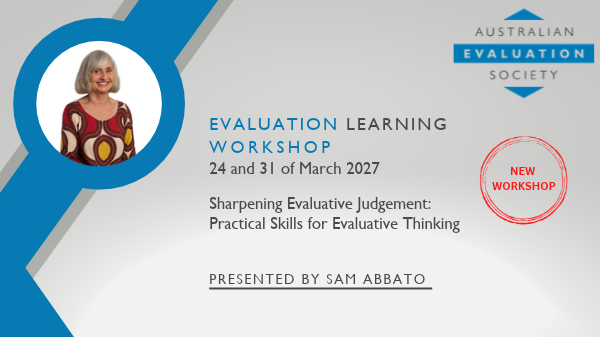
Workshop: Sharpening Evaluative Judgement: Practical Skills for Evaluative Thinking
Date and time: Wednesday 24 March and Wednesday 31 March 2027, 9.30am to 1.00pm AEDT (registration from 9.15am). Registrants are to attend both sessions. (full day workshop - 2 sessions)
Venue: Via Zoom. Details will be emailed to registrants just prior to the workshop start time
Facilitator: Dr. Samantha Abbato
Register online by: 23 March 2027, unless sold out. Spaces limited to 25 participants
Fees (GST inclusive): Members $400.00, AES Organisational member staff $525.00, Non-members $609.00, Student member $200.00, Student non-member $300.00* *Students must send proof of their full-time student status to
Workshop Overview
Good evaluation isn't just about picking the right method — it depends on the quality of thinking behind every decision along the way. This workshop gets under the hood of evaluative thinking: the blend of critical, reflective, practical, and creative reasoning that shapes how evaluators choose methods, interpret evidence, and reach defensible judgements about merit and worth. Strong evaluative thinking ultimately supports well-founded recommendations and better-informed decisions and actions.
Using an interactive, games-based approach, participants will practise nine core evaluative thinking skills and learn to recognise and counter eight common threats to good reasoning — from confirmation bias to groupthink. Rather than a lecture on theory, this is a hands-on session built around case studies, serious games, and real evaluation scenarios, designed to leave participants with tools they can apply immediately.
Workshop Content
- Foundations - the emergence of evaluative thinking as a disciplined approach to inquiry and reflective practice in evaluation, and its role in supporting evaluation culture, evaluative attitudes, processes, and judgement
- Building the skills - through case studies and serious games, practise nine distinct thinking approaches (e.g., evidence-based, probabilistic, empathetic) and learn to manage eight major threats to sound thinking (e.g., confirmation bias, groupthink)
- Bringing it home - a practical, stepwise approach to embedding these skills into your own evaluation practice, processes, and capacity-building initiatives
Workshop Outcomes
By the end of this workshop, participants will be able to:
- Explain why evaluative thinking is a foundational skill underpinning evaluation practice, evaluative attitudes, reasoning, methods, and processes
- Identify and practise nine key evaluative thinking skills
- Recognise and manage major threats to sound evaluative thinking
- Apply a practical pathway for building evaluative thinking into their own evaluation projects, capacity-building work, and collaborations
PL competencies
This workshop aligns with competencies in the AES Evaluator’s Professional Learning Competency Framework. The identified domains are
-
Domain 1 – Evaluative attitude and professional practice
-
Domain 2 – Evaluation theory
-
Domain 3 – Culture, stakeholders and context
-
Domain 4 – Research methods and systematic inquiry
-
Domain 5 – Project management
-
Domain 6 – Interpersonal skills
-
Domain 7 – Evaluation Activities
Who should attend?
This workshop is relevant to:
-
Evaluators at any career stage looking to sharpen their reasoning and judgement
-
Commissioners and funders of evaluation who want to better assess evaluation quality
-
Evaluation leaders and teams building organisational evaluation capacity (ECB)
-
Anyone new to evaluation who wants a strong reasoning foundation before diving into methods
No prior evaluation experience is required — the workshop is structured to be equally valuable for newcomers and experienced practitioners.

Workshop start times
-
VIC, NSW, ACT, TAS: 9.30am
-
QLD: 8.30am
-
SA,: 9.00am
-
NT: 8.00am
-
WA: 6.30am
-
New Zealand: 11.30am
-
For other time zones please go to https://www.timeanddate.com/worldclock/converter.html
About the facilitator
Dr Samantha Abbato brings over two decades of evaluation experience to this workshop, alongside an academic grounding that spans health science (physiology and epidemiology), mathematics, and social science (public health and medical anthropology). This cross-disciplinary background allows Sam to draw on examples of clear and critical thinking from far beyond the evaluation field, bringing fresh perspectives to how evaluators reason and make judgements.
Sam has developed a distinctive picture, story, and serious-games approach to teaching evaluative thinking, which has been used successfully with evaluators, commissioners, and organisational leaders — including many new to the field. This approach has been refined through numerous AES workshops over the past five years, including Foundations of Evaluation: Evaluative Thinking and Theory (AES online, 2024) and sessions on bias and credibility in evaluation delivered at AES23 Brisbane and AES24 Melbourne, as well as through extensive work with not-for-profit and government clients over the past three years.
Participants consistently respond to Sam's engaging, interactive style, which turns often abstract concepts into practical, memorable skills that evaluators can apply straight away.
Event Information
| Event Date | 24 Mar 2027 9:30am |
| Event End Date | 31 Mar 2027 1:00pm |
| Cut Off Date | 23 Mar 2027 4:00pm |
| Location | Zoom |
| Categories | March Workshops |
We acknowledge the Australian Aboriginal and Torres Strait Islander peoples of this nation. We acknowledge the Traditional Custodians of the lands in which we conduct our business. We pay our respects to ancestors and Elders, past and present. We are committed to honouring Australian Aboriginal and Torres Strait Islander peoples’ unique cultural and spiritual relationships to the land, waters and seas and their rich contribution to society.