Award winner spotlight 2026

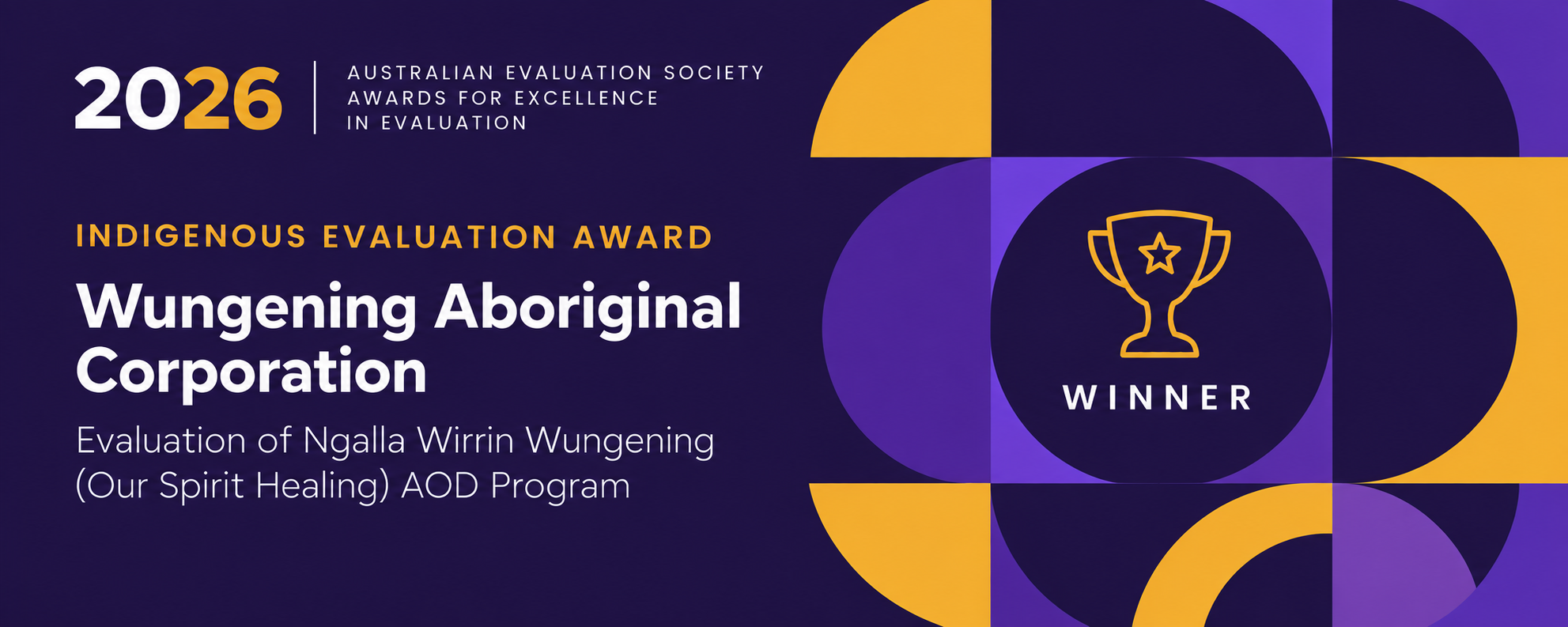
2026 Indigenous Evaluation Award awarded to Wungening Aboriginal Corporation

 Congratulations to the 2026 awards recipients

For each Award, click "Read more" and scroll down to see the details 


2026 Indigenous Evaluation Award awarded to Wungening Aboriginal Corporation

Evaluation of Ngalla Wirrin Wungening (Our Spirit Healing) AOD Program
Wungening Aboriginal Corporation receives the 2026 Indigenous Evaluation Award for its evaluation of the Ngalla Wirrin Wungening (Our Spirit Healing) AOD Programme. By bringing developmental evaluation together with Aboriginal methodologies including Impact Yarns, storytelling, co-research and collective sense-making, the evaluation offers a powerful example of culturally grounded evaluation practice.

2026 Emerging New Talent Award awarded to Daniel Vogels

Daniel Vogels is the recipient of the 2026 Emerging New Talent Award, recognising an evaluator already making a significant contribution to evaluation practice, capability and community. Since beginning his evaluation career in 2021, Daniel has combined strong technical practice with a commitment to making evaluative reasoning visible, transparent and useful.

2026 Evaluation System Award awarded to First Person Consulting and The Department of Energy, Environment, and Climate Action

Evaluation Framework for the Sustainability Fund
First Person Consulting receives the 2026 Evaluation System Award for developing an integrated monitoring and evaluation system for the Victorian Government’s Sustainability Fund. Covering almost $2 billion in investment and hundreds of initiatives, the system brings consistency and evaluative thinking to an exceptionally diverse portfolio of environmental programs.

2026 Enhancing the Social Good Award awards to Legal Aid Western Australia and Visual Insights

DARDY Project evaluation
Legal Aid Western Australia receives the 2026 Enhancing the Social Good Award for its evaluation of the Disability Advocacy and Referral Diversion for Young People (DARDY) Project. The evaluation demonstrates how culturally safe, practical and deeply contextual evaluation can strengthen a service while helping secure better outcomes for young people experiencing disadvantage.

2026 EJA Publication Award awarded to Kerryn Meldrum and Amy M. Gullickson

Stairways to Heaven? Seeking Evaluative Reasoning in Publicly Available Evaluation Reports from the Australian Education Sector 2014–2024.
Kerryn Meldrum and Amy M. Gullickson receive the 2026 Evaluation Journal of Australasia Publication Award for Stairways to Heaven? Seeking Evaluative Reasoning in Publicly Available Evaluation Reports from the Australian Education Sector 2014–2024. Their article tackles a fundamental question for evaluation: are reports labelled “evaluations” actually reaching defensible judgements about the value of the programs they examine?

2026 Public Sector Evaluation Award: Clear Horizon and The Commonwealth Department of Health, Disability and Ageing

Evaluation of Regional Stewardship of Aged Care 2023–26
Clear Horizon receives the 2026 Public Sector Evaluation Award for its Evaluation of Regional Stewardship of Aged Care 2023–26. Combining developmental evaluation with a rigorous value for money approach, the evaluation has supported the Australian Government to strengthen an emerging model of aged care stewardship while building evidence for future investment and decision-making.

2026 Indigenous Evaluation Award awarded to Wungening Aboriginal Corporation

Evaluation of Ngalla Wirrin Wungening (Our Spirit Healing) AOD Program
Wungening Aboriginal Corporation receives the 2026 Indigenous Evaluation Award for its evaluation of the Ngalla Wirrin Wungening (Our Spirit Healing) AOD Programme. By bringing developmental evaluation together with Aboriginal methodologies including Impact Yarns, storytelling, co-research and collective sense-making, the evaluation offers a powerful example of culturally grounded evaluation practice.

At the heart of the evaluation was an approach that privileged Aboriginal ways of knowing, being and doing while supporting continuous learning and improvement within the organisation.

The evaluation involved strong engagement with Aboriginal participants, staff and organisational leaders. Methods such as Impact Yarns and storytelling created opportunities for people’s experiences and knowledge to meaningfully shape both the evidence and the conclusions drawn from it.

Importantly, the evaluation was not simply an exercise in reporting. Findings have already contributed to service improvement, strengthened organisational capability and supported ongoing learning. Videos and other dissemination activities have extended participation in the evaluation and helped make its findings accessible and useful.

The evaluation also makes a broader contribution to Indigenous evaluation practice, particularly within Aboriginal alcohol and other drug services.

Its thoughtful integration of developmental evaluation with Aboriginal methodologies provides a valuable model for culturally responsive evaluation that has relevance well beyond the immediate program.


About the Indigenous Evaluation Award

This Award recognises Indigenous evaluation practice. This includes evaluations led by Indigenous peoples, and/or conducted in partnership with Indigenous peoples. It also recognises evaluation capacity building with Indigenous peoples in Australia, New Zealand, Papua New Guinea, and Pacifica.

Work nominated for the Award should:

  • generate positive impacts for the Indigenous communities
  • nurture Indigenous self-determination and sustainability#
  • empower Indigenous people in evaluation practice##
  • strengthen the accountability of Indigenous evaluation.

Recipients of this Award agree to publish their evaluation products on the AES website.

# The underlying intent of this point is to encourage a conceptual shift in practice from doing evaluations on Indigenous peoples towards doing evaluations with, and/or by, Indigenous peoples. For further guidance on the meaning of Indigenous self-determination and sustainability in this context, please refer to the descriptions in the Australian Institute of Aboriginal and Torres Strait Islander Studies Code of Ethics for Aboriginal and Torres Strait Islander Research – Consultation Draft, 2019. Non-Indigenous and First Nations evaluators can refer to the AES (2021) First Nations Cultural Safety Framework for further guidance on principles and practices for moving towards culturally safe evaluations.

## Empowerment may include work in building evaluation capacity, building a culture of evaluation, and/or an awareness and interest in evaluation, and evaluation policy development. Nominations are assessed by a panel of Indigenous peers.


ABOUT US   |    CONTACT US   |    LEGALS
Search site
© 2026 Australian Evaluation Society Limited 
ABN 13 886 280 969 ACN 606 044 624
425 Smith Street, Fitzroy, Victoria, 3065, Australia

We acknowledge the Australian Aboriginal and Torres Strait Islander peoples of this nation. We acknowledge the Traditional Custodians of the lands in which we conduct our business. We pay our respects to ancestors and Elders, past and present. We are committed to honouring Australian Aboriginal and Torres Strait Islander peoples’ unique cultural and spiritual relationships to the land, waters and seas and their rich contribution to society.