Award winner spotlight 2026

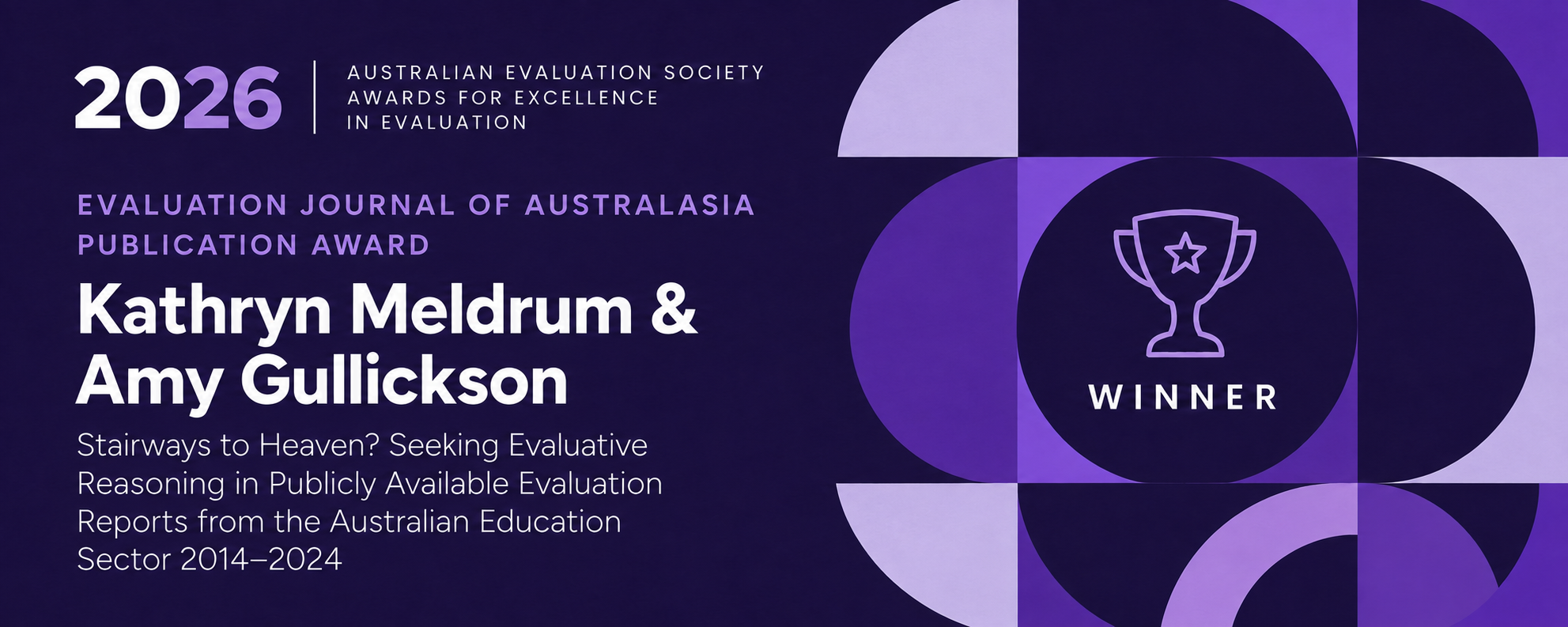
2026 EJA Publication Award awarded to Kerryn Meldrum and Amy M. Gullickson

 Congratulations to the 2026 awards recipients

For each Award, click "Read more" and scroll down to see the details 


2026 Indigenous Evaluation Award awarded to Wungening Aboriginal Corporation

Evaluation of Ngalla Wirrin Wungening (Our Spirit Healing) AOD Program
Wungening Aboriginal Corporation receives the 2026 Indigenous Evaluation Award for its evaluation of the Ngalla Wirrin Wungening (Our Spirit Healing) AOD Programme. By bringing developmental evaluation together with Aboriginal methodologies including Impact Yarns, storytelling, co-research and collective sense-making, the evaluation offers a powerful example of culturally grounded evaluation practice.

2026 Emerging New Talent Award awarded to Daniel Vogels

Daniel Vogels is the recipient of the 2026 Emerging New Talent Award, recognising an evaluator already making a significant contribution to evaluation practice, capability and community. Since beginning his evaluation career in 2021, Daniel has combined strong technical practice with a commitment to making evaluative reasoning visible, transparent and useful.

2026 Evaluation System Award awarded to First Person Consulting and The Department of Energy, Environment, and Climate Action

Evaluation Framework for the Sustainability Fund
First Person Consulting receives the 2026 Evaluation System Award for developing an integrated monitoring and evaluation system for the Victorian Government’s Sustainability Fund. Covering almost $2 billion in investment and hundreds of initiatives, the system brings consistency and evaluative thinking to an exceptionally diverse portfolio of environmental programs.

2026 Enhancing the Social Good Award awards to Legal Aid Western Australia and Visual Insights

DARDY Project evaluation
Legal Aid Western Australia receives the 2026 Enhancing the Social Good Award for its evaluation of the Disability Advocacy and Referral Diversion for Young People (DARDY) Project. The evaluation demonstrates how culturally safe, practical and deeply contextual evaluation can strengthen a service while helping secure better outcomes for young people experiencing disadvantage.

2026 EJA Publication Award awarded to Kerryn Meldrum and Amy M. Gullickson

Stairways to Heaven? Seeking Evaluative Reasoning in Publicly Available Evaluation Reports from the Australian Education Sector 2014–2024.
Kerryn Meldrum and Amy M. Gullickson receive the 2026 Evaluation Journal of Australasia Publication Award for Stairways to Heaven? Seeking Evaluative Reasoning in Publicly Available Evaluation Reports from the Australian Education Sector 2014–2024. Their article tackles a fundamental question for evaluation: are reports labelled “evaluations” actually reaching defensible judgements about the value of the programs they examine?

2026 Public Sector Evaluation Award: Clear Horizon and The Commonwealth Department of Health, Disability and Ageing

Evaluation of Regional Stewardship of Aged Care 2023–26
Clear Horizon receives the 2026 Public Sector Evaluation Award for its Evaluation of Regional Stewardship of Aged Care 2023–26. Combining developmental evaluation with a rigorous value for money approach, the evaluation has supported the Australian Government to strengthen an emerging model of aged care stewardship while building evidence for future investment and decision-making.

2026 EJA Publication Award awarded to Kerryn Meldrum and Amy M. Gullickson

Stairways to Heaven? Seeking Evaluative Reasoning in Publicly Available Evaluation Reports from the Australian Education Sector 2014–2024.
Kerryn Meldrum and Amy M. Gullickson receive the 2026 Evaluation Journal of Australasia Publication Award for Stairways to Heaven? Seeking Evaluative Reasoning in Publicly Available Evaluation Reports from the Australian Education Sector 2014–2024. Their article tackles a fundamental question for evaluation: are reports labelled “evaluations” actually reaching defensible judgements about the value of the programs they examine?

Meldrum and Gullickson analysed 37 publicly available Australian education sector evaluation reports published between 2014 and 2024. Using their framework, they found that only four—around 11 per cent—met their definition of a genuine evaluation.

Many reports collected and analysed evidence carefully but stopped short of making an explicit, defensible judgement about the quality, value or significance of the program being examined.

The authors show why that distinction matters. Their integrated framework brings together the logic of evaluation and evaluative reasoning, identifying the elements needed to move from evidence to judgement: criteria of merit, standards of performance, evidence assessed against those standards, synthesis and an explicit evaluative conclusion.

The article’s “stairways to heaven” model makes these ideas particularly accessible. It presents research and evaluation as two staircases beginning from a common landing but leading towards different destinations, helping evaluators and commissioners distinguish between the questions each type of inquiry is designed to answer.

The article also recognises the practical constraints under which evaluations are commissioned and undertaken, including time, budget and the appetite for critical findings. Rather than simply identifying shortcomings, the authors propose a pragmatic response: where elements of evaluative reasoning are absent, reports should explicitly identify what is missing and explain why.

Combining theoretical rigour with a practical framework that can improve commissioning, evaluation practice and reporting, the article makes an important contribution to strengthening the quality and transparency of evaluation.

DOI: 10.1177/1035719X251412530


About the Evaluation Journal of Australasia Publication Award

This Award recognises the best article published in the Evaluation Journal of Australasia (EJA) in the last 12 months. The Award is a joint initiative of the EJA editors and the AES Awards and Recognition Working Group. The EJA editors make the selection based on a review of all eligible articles in relation to professionalism, ethical conduct and the quality of the publication.

A quality publication will contain the following attributes:

  • sound use of evaluation theory and approaches
  • includes a literature review to substantiate the relevance of the evaluative study and context
  • contributes significantly to scholarship, research, and/or pedagogy
  • demonstrates originality of thought and careful investigation
  • is well-written and engaging for its intended audience.

ABOUT US   |    CONTACT US   |    LEGALS
Search site
© 2026 Australian Evaluation Society Limited 
ABN 13 886 280 969 ACN 606 044 624
425 Smith Street, Fitzroy, Victoria, 3065, Australia

We acknowledge the Australian Aboriginal and Torres Strait Islander peoples of this nation. We acknowledge the Traditional Custodians of the lands in which we conduct our business. We pay our respects to ancestors and Elders, past and present. We are committed to honouring Australian Aboriginal and Torres Strait Islander peoples’ unique cultural and spiritual relationships to the land, waters and seas and their rich contribution to society.