Last chance to register! |
|
|---|
QLD Seminar: Causal reasoning in program evaluation: A critical review (Online 14 May 2026) 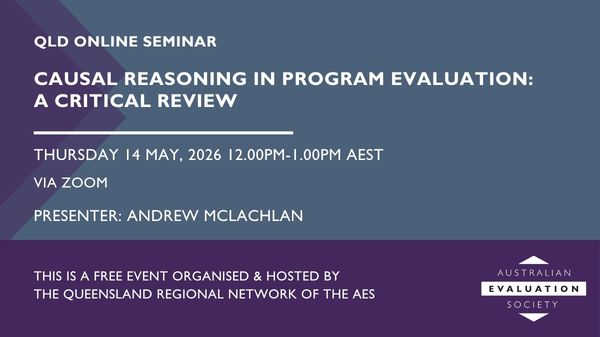
Date and time: Thursday 14 May 12.00pm - 1.00pm AEST
Topic: Causal reasoning in program evaluation: A critical review
Venue: Via Zoom. Details will be emailed to registrants just prior to the start time
Presenter: Andrew Mclachlan | QLD Regional Committee
Register online by: 13 May 2026
Event description:
Most evaluations rely on causal claims, yet evaluators often use tools such as logic models and theories of change without making their underlying assumptions explicit. This presentation argues that strengthening causal reasoning requires greater clarity about the logics through which causal claims are warranted (Gates and Dyson 2017).
Drawing on philosophical and methodological work on causation, the presentation discusses a pluralistic account that distinguishes between relations of dependence (e.g. regularity, probabilistic, and counterfactual approaches) and relations of production (e.g. process, dispositional, and conjunctural accounts) (Hall 2004). Each operates according to distinct rules for making causal claims, with implications for how evidence is interpreted and arguments are justified.
The presenter then demonstrates how different causal logics can be combined to strengthen evaluative reasoning. Using an illustrative example, it shows how realist context–mechanism–outcome (CMO) configurations (Pawson and Tilley 1997) and Mackie’s INUS conditions (Mackie 1965) offer complementary accounts of causality. The paper concludes that no single causal theory is sufficient for all evaluative purposes. Instead, evaluators must draw on multiple causal logics to construct coherent, plausible, and contextually appropriate causal arguments.
Presenter details:
Andrew McLachlan has over ten years’ experience in educational research, evaluation, and policy, including senior roles within the NSW Department of Education, with a focus on knowledge translation and implementation science. He has presented at Australian Evaluation Society conferences, the Implementation Science Interest Group (ISIG), and the Centre for Advancement in Realist Evaluation and Synthesis (CARES). His work draws on large-scale system reform and evaluation, where robust and defensible causal reasoning is essential to informing policy and practice.
This seminar will be recorded and available on the member portal only.
This free event has been organised by the QLD Regional Network of the AES. Our seminar series provides an opportunity for you to meet with AES members and others in the evaluation community and to share and learn from the experiences of fellow evaluators. Please also check your email address is correct on your registration form before submitting.
Session start times:
-
NSW, VIC ,QLD, ACT, TAS: 12.00pm
-
SA, NT: 11.30am
-
WA: 10.00am
-
New Zealand: 2.00pm
For other time zones please go to https://www.timeanddate.com/worldclock/converter.html
Please ensure you have access to your email address just prior to the start time to access Zoom details. Please also check your email address is correct on your registration form before submitting. Thanks.
|
|
|---|
SA Seminar: Governance & Strategic Evaluation – Quo vadis? (Online 26 May 2026) 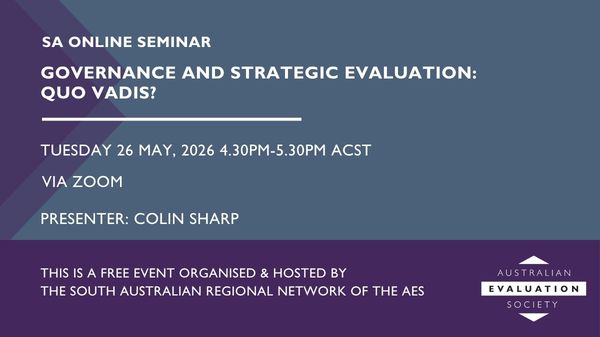
Date and time: Tuesday 26 May 4.30pm -5.30pm ACST
Topic: Governance & Strategic Evaluation – Quo vadis?
Location: online via zoom, details will be shared just prior to the event
Presenter: Colin Sharp | Adelaide University
Register online by: 25 May 2026
Event description:
“Strategic Evaluation” is a term coined by Sharp (1996a, 1996b, 1998a, 1998b, 1999) to encompass the role of evaluation in the strategy, performance and governance of an organisation. Governance Professionals, especially Board Directors have an important, but seldom recognized, role in the highest level of organizational performance evaluation. Recent failures of corporate governance in a variety of organisations have prompted concerns as to the purpose, competencies and professionalism of Board Directors. Similarly, the emergence of the disturbing laxity of Bord Directors in upholding their governance roles and goals suggests the need for a better way forward, especially developing better evaluation and accountability processes.
Here it is proposed to require Directors’ commitment to a standardized goal attainment contract such as developed in the Directors’ Effectiveness Self-Evaluation Research Tool (D.E.S.E.R.T.). strategic evaluation model (Sharp, 1999; ). This model entails directors clarify their governance role and associated goals, then identify the relevant risks of various potential outcomes so as to set Goal Attainment Scales for their evaluation and accountability. The model will be illustrated and offered for discussion.
Presenter details:
Associate Professor Colin Sharp, PhD, FAES, FGIA has been a Foundation Committee Member (1987- 1990), Foundation Chair of the Committee for Ethics and Standards in Evaluation (1988 – 1995), Editor of the Evaluation Journal of Australasia and former President (1994 – 1995) of the Australasian Evaluation Society (AES). His contribution to program evaluation has been recognised by receiving the Outstanding Contribution to Evaluation Award (formerly the ET&S Award) in 1992, and given the title of Fellow of the AES (2003, Life Member, 2024), as well as being featured in the Evaluation Journal of Australia (Evaluator Perspective (sagepub.com) 2021. He has been a Member of the Australian Institute of Company Directors (AICD) for over ten years, and Fellow of the Governance Institute of Australia (GIA) for 15 years. He was Chair of the Subject Management Team on the public sector courses in the Diploma of Applied Corporate Governance for the GIA (2009 – 2025) and member of the GIA Academic Board. Since 2022 he has been an Adjudicator for the Australasian Annual Report Awards Special Award for Governance.
He offers over 40 years of experience in evaluation, management and governance roles.
This seminar will be recorded and available on the member portal for AES members only.
This free event has been organised by the SA Regional Network of the AES. Our seminar series provides an opportunity for you to meet with AES members and others in the evaluation community and to share and learn from the experiences of fellow evaluators. Please ensure you have access to your email address to receive the zoom details. Please also check your email address is correct on your registration form before submitting.
Session start times:
SA, NT: 4.30pm
VIC, NSW, ACT, QLD, TAS : 5.00pm
WA: 3.00pm
NZ: 7.00pm
For other time zones please go to https://www.timeanddate.com/worldclock/converter.html |
|
|---|
NSW Interactive Session: More than vibes: A practical guide to evaluative synthesis (Online 28 May 2026) 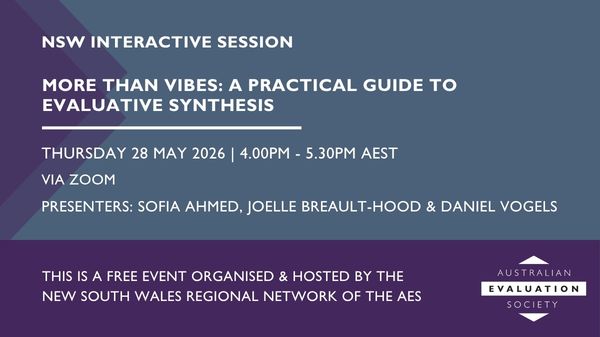
Date and time: Thursday 28 May 4.00pm -5.30pm AEST
Topic: NSW Interactive Session: More than vibes: A practical guide to evaluative synthesis
Location: online via zoom, details will be shared just prior to the event
Presenter(s): Sofia Ahmed, Joelle Breault-Hood and Daniel Vogels | NSW Department of Education
Register online by: 27 May 2026
Event description:
We’ve all been there: you’ve got a heap of findings – some of them pointing one way and some of them another. You’ve got qual and quant data, some tangentially relevant and some critically important.
In this session, Sofia Ahmed, Joelle Breault-Hood and Daniel Vogels will share their experience of how to get to a believable conclusion for your evaluation, even when the evidence is mixed or contradictory. They’ll suggest an approach for moving from mixed findings to an overall conclusion that can’t be framed by audiences as just vibes.
The session will step you through using rubrics to develop a “qualitative weight and sum” synthesis process that supports evaluative reasoning and is also stakeholder-friendly. The presenters will share how they have adapted published weight-and-sum methods, using a central bar of sufficiency to structure judgements, and show how different findings pull an overall conclusion in a more positive or negative direction. You’ll have a chance to see the approach in action as the presenters show you an example from their own work, where they’re using this approach to judge the quality of the support they’re providing to their own stakeholders.
The session is going to be rigorous, lively, practical and interactive, and it’s aiming to get you thinking about how you make judgements at different points in the synthesis process. Come along to hear about a practical solution to a perennial problem, and discuss how this kind of approach could be used in planning, conducting and reporting evaluations – for all evaluators who want their synthesis to rest on more than vibes.
Presenter details:
Sofia Ahmed is an evaluator with more than 18 years’ experience in public policy and research, with a strong focus on educational equity. She holds a PhD in education economics and has taught applied spatial econometrics at postgraduate level.
Joelle Breault-Hood is a senior developmental evaluation officer and qualitative analysis specialist who began her career in outdoor education and earned a PhD in outdoor physical activity and women’s body image. She specialises in building evaluation capacity and helping ensure findings are practical and useful for stakeholders.
Daniel Vogels is a senior developmental evaluation officer with a background in primary teaching. He holds a Graduate Certificate in Data Science and a Master of Evaluation, and is interested in translating evaluation theory into practical tools and methods.
This seminar will be recorded and available on the member portal for AES members only.
This free event has been organised by the NSW Regional Network of the AES. Our seminar series provides an opportunity for you to meet with AES members and others in the evaluation community and to share and learn from the experiences of fellow evaluators. Please ensure you have access to your email address to receive the zoom details. Please also check your email address is correct on your registration form before submitting.
Session start times:
VIC, NSW, ACT, QLD, TAS: 4.00pm
NT, SA: 3.30pm
WA: 2.00pm
NZ: 6.00pm
For other time zones please go to https://www.timeanddate.com/worldclock/converter.html |
|
|---|
| You have received this email because you are subscibed to an AES mailing list.
Unsubscribe
|
|
|---|
|
|

